WiseTrips
Croatia or Greece for a family vacation, with school-age kids in tow? Greece is the easier answer if your kids are 5 to 8 and you want sand, shallow water, and no real planning. Croatia is the better trip for 9- to 12-year-olds who’ll trade pebbly beaches for medieval walls and cliff jumps. The honest version is messier, and depends mostly on heat tolerance, ferry days, and what your week actually costs.
I’ve taken my kids to both in the dead heat of July. The Bol pebble beach where my 7-year-old slid off a rock the size of a cantaloupe, landed in the sea on her bottom, and laughed while a stranger handed over a slice of watermelon. The 6:30 a.m. catamaran out of Naxos because the Meltemi was forecast to turn the noon ferry into a misery cruise. Both trips were great. They were nothing alike.
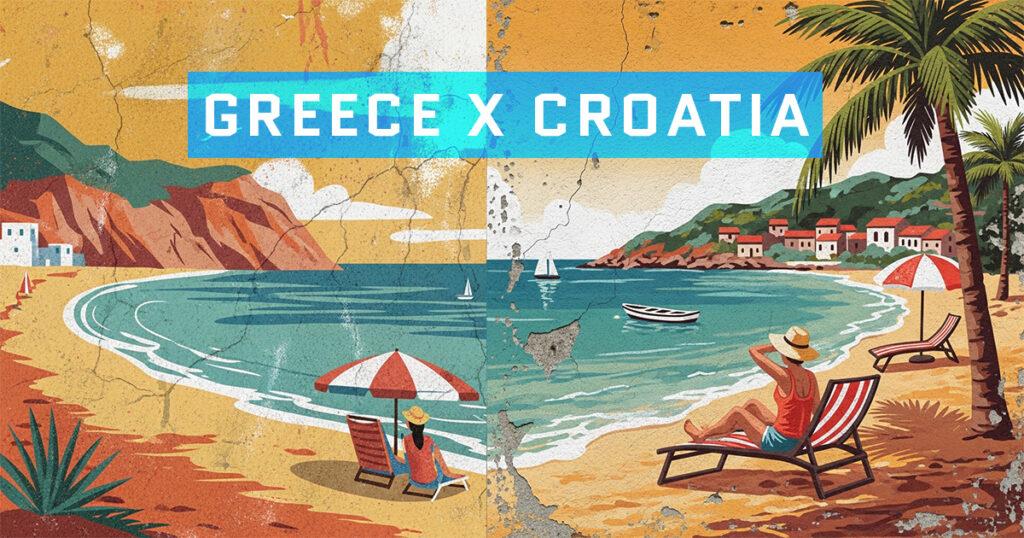
The short answer: Croatia or Greece for a family vacation?
If you have school-age kids between 5 and 12 and you’re trying to pick one, here’s the version I’d give a friend over coffee.
Pick Greece if your kids are on the younger end (5 to 8), shallow sandy beaches matter more than scenery, you want one base for the whole week, and you’re willing to fly into Athens and either ferry or fly onward to one island. The beaches do the work for you. Naxos, Paros, and parts of Crete are made for younger swimmers.
Pick Croatia if your kids are 8 or older, can swim confidently in clear deep water, and you want to mix beach time with cobblestone exploring, kayaking, or national-park waterfalls. The Dalmatian coast is dense and drivable. You can move every two or three nights without a logistical headache. Cliff jumping is the great-equalizer activity for kids who’ve outgrown sand-pit beach mode.
Pick neither in mid-August if you can flex. The first half of June or the second half of August are the sweet spots in both countries. School-holiday pressure during late July and the first half of August stacks European, Greek, and (in Croatia) increasingly American demand into the same fortnight, and you’ll feel it in prices, beach crowds, and ferry tickets.
If you want one sentence: Greece for the beach, Croatia for the trip.
Beaches with kids: sand, pebbles, and the water shoe question
This is the question that decides the holiday for most families with younger kids, and the answer is genuinely different between the two countries.
Greek beaches, especially in the Cyclades, are sandy. Not patchy-sand. Real, fine, walk-into-the-water-for-fifty-meters-and-still-be-knee-deep sand. Agios Georgios on Naxos is the obvious example: a long shallow bay with lifeguards, a row of tavernas at the back, and a bottom you can see your toes in 200 meters offshore. Agia Anna on the same island is a smaller version of the same thing. Elafonissi on the southwest tip of Crete is the spectacular one — pink-tinted sand, water that stays shin-deep for a long way, and (let’s be honest) a 90-minute drive from anywhere worth staying. Rhodes has the kind of beaches kids point to in books, plus a working water park at Faliraki for the inevitable rainy or windy day.
Croatian beaches are pebbles. All of them, basically. Even the famous ones. Zlatni Rat on Brač, the spit in every Croatia tourism photo, is rocks. They are smooth, ankle-rolling, white rocks, and the water beyond them is the clearest you’ll ever swim in, but they are not sand. The seabed shelves more steeply than in Greece, sometimes a meter from shore, sometimes fifty. A 6-year-old who’s not yet a strong swimmer needs a parent’s hand most of the time.
There are two practical workarounds for Croatia’s pebble problem with kids, and you’ll want both.
The first is water shoes. Buy them. A €10 pair from any beach kiosk in Split, Hvar, or Dubrovnik will save your trip. The pebbles get hot enough by noon that adults wince walking on them; kids’ feet give up faster. Snug rubber-soled shoes also matter because of sea urchins on rocky outcrops and the small chance of a weever fish in sandier patches. I bought a pair for each of my kids on day one in Split and they wore them every single beach day after that, in and out of the water.
The second is choosing your beach by family-fit, not by Instagram fame. Bol on Brač and Banje in Dubrovnik are the easiest with school-age kids. Both have shower facilities, lifeguards, and food within fifty steps. Saharun on Dugi Otok is one of the rare actually-sandy beaches in Croatia and worth the day trip if you’re in the Zadar area. Skip the cliff-edge swimming spots until your kids are 9 or 10; the entry is a metal ladder bolted into the rock, which is fun for confident swimmers and stressful for everyone else.
Net of all that: Greece will do a 5-year-old’s beach day for you. Croatia needs you to pack a little more and choose more deliberately.
Getting around with school-age kids: ferries vs the Dalmatian coast drive
This is the underrated comparison, the one that quietly decides whether a family week feels like a holiday or a logistics exercise.
Greece’s geography forces ferries on you. Even a short island combo like Naxos and Paros means at least one transit day at each end and probably one in the middle. Piraeus to Naxos on the fast Seajets is 3 hours 15 minutes; on the conventional Blue Star ferry it’s closer to 5. Tickets in July and August run €22 to €88 per adult, with kids 4 to 12 at half price and under-4s free. Paros is a 30-minute hop from Naxos. None of these are bad in isolation. Stack two of them into a 10-day trip and you’ll spend the equivalent of a full day on docks, terminals, and the X96 bus from the airport.
A few things real ferry-day travel with kids has taught me. Always book Blue Star over Seajets if anyone in the family gets seasick; the conventional ferries have stabilizers, open-deck access, and proper toilets, and the Meltemi can shake the high-speed catamarans into something rough from late July through August. Always book the airport-to-Piraeus train (about 60 minutes, €9 in 2026) or a pre-booked transfer rather than the X96 bus when you’ve got luggage and tired kids. Always pack a dinner-sized snack bag because the on-board cafes run out of anything appealing by hour two.
Croatia’s geography rewards a car. The A1 motorway from Zagreb to Split is one of the easiest drives in Europe. Four hours, €30 or so in tolls, and the second half winds along the coast as the Dinaric Alps drop into the Adriatic. From Split, the Dalmatian coastal road takes you to Trogir in 30 minutes, the islands of Brač and Hvar in under an hour by catamaran, and Dubrovnik in 4 hours by car or 5 by coastal bus. The catamarans run up to 17 daily crossings between Split and Hvar in summer and cost €8 to €25 per adult, with kids under 2 free and 2 to 12 at half fare. You can change base every two or three nights and cumulatively spend less time in transit than you’d spend on a single Athens-to-island travel day.
The other thing to know about Croatian ferries: they don’t allow cars on the catamarans into Hvar Town. If you’re driving, you take the car ferry to either Stari Grad on Hvar (2 hours) or Supetar on Brač (50 minutes), then drive the rest. For a family this is usually fine. You can leave the car at the Split ferry port for around €15 a day and walk on with a backpack each. We did this for three nights on Hvar and it worked well.
Practical rule of thumb: if your kids are 5 or 6 and your patience for transit days is low, do Greece on a single island for the entire week and pay a little more for direct flights into Heraklion or Rhodes. If your kids are 8 and up and you want to see things, Croatia gives you more variety per dollar and per hour.
The July and August heat (and what it actually feels like with a 7-year-old)
This is the one most comparison articles soft-pedal. Both countries are hot in peak summer. The difference is what kind of hot, and what it does to a small person on day five.
Greek islands in July average 28 to 32°C. Inland and on the southern islands (Crete, Rhodes), it climbs to 35°C and during heatwaves to 40°C. The Greek Ministry of Culture has closed the Acropolis between 1 p.m. and 5 p.m. for visitor safety on the worst recent days. The stone radiates. There’s almost no shade. Even on the islands, the late-morning to mid-afternoon stretch is unsafe for small children to be out without a hat, water, and a plan.
The Greek pattern that works for families is local: be on the beach by 8, off it by 12, in air-conditioning or a pool for the worst three hours, back outside at 5, dinner around 8 or 9. It takes two days to settle into and then it’s fine. The thing that surprises first-time visitors is how universally this is observed. Tavernas in beach villages thin out at 1 p.m. and refill at 7. If you fight the rhythm, you’ll be miserable. If you adopt it, you’ll be the family eating dinner under a fig tree at 9 p.m. with kids running between tables, which is the actual point of the trip.
Croatia in July averages 27 to 30°C, sometimes touching 35. The dampness off the sea makes it feel a touch more humid than the Cyclades, but the scenery does more shade work. The old city of Dubrovnik has narrow stone alleys, Hvar’s pine forests come close to the beaches, and Plitvice Lakes is essentially an air-conditioned forest. The siesta rhythm is less rigid. Locals are out at lunchtime; restaurants don’t shut.
Two specific things to plan around. Plitvice Lakes National Park is a 4-hour day if you do it well, and you should start at 7:30 a.m. The 8 km lower-circuit walk has zero hill but a lot of wooden boardwalks in full sun by 11. Buy tickets online the night before; entry runs around €40 in July for adults, half for kids 7 to 18, free under 7. The other one: don’t underestimate the steepness of Dubrovnik’s old town. The marble has been polished by 600 years of feet and gets slick when wet. Kids in flip-flops will fall. Sandals with a real grippy sole are the move.
If anyone in your family runs hot or struggles in heat, the honest call is to push the trip to early June or after August 25. Both countries are still warm enough for swimming (sea temps 23 to 25°C), prices drop, and the worst of the heat is gone.

What a mid-range family week actually costs in Croatia vs Greece
Older travel writing said Greece was more expensive than Croatia. The reverse is closer to true now in many of the popular destinations, especially since Croatia adopted the euro and Dubrovnik became a cruise-ship marquee. For a family of four traveling mid-range in July or August, here’s what I’ve actually paid in 2024 and 2025, with the figures adjusted to what I’d budget for summer 2026.
A two-bedroom apartment with a kitchen runs €150 to €220 a night in mid-range parts of Naxos, Paros, or Crete; €180 to €260 in Bol on Brač or Hvar Town; and €220 to €350 in central Dubrovnik. A 3-star family hotel with a pool tends to run about 20% more than the apartment equivalent.
Daily food for a family of four, eating one tavern lunch and one tavern dinner with the rest from a bakery and supermarket, runs €60 to €90 in Greece and €70 to €110 in Croatia. The gap is real and noticeable. A family pizza in a Croatian island town goes for €18 to €24; the same in Greece, €14 to €18. Coffee, gelato, beach umbrellas, water-park entries: all 15 to 25% more in Croatia than Greece in my experience.
Car rentals in Croatia run €40 to €70 a day in summer for a small family car; in Greece, €35 to €60. Ferries are roughly comparable per-mile, though as noted you’ll do more of them in Greece.
A realistic 7-night, mid-range, family-of-four budget, excluding flights:
- Greece (one island, apartment-based): €2,400 to €3,400
- Croatia (Split base + 3 nights on Hvar or Brač, apartments): €2,800 to €4,000
The Greek figure assumes you’re sticking to one island. Add a second island with two ferry days and you’ll add €350 to €500 to the trip. Croatia’s figure assumes you have a rental car and are using catamarans for inter-island hops, not driving onto car ferries.
Short version: Croatia is currently around 15 to 25% more expensive than Greece for an equivalent family week, and the gap is widest in the Dubrovnik–Split corridor and narrowest in inland or Istrian Croatia (Pula, Rovinj) where prices are still reasonable.
Food, late dinners, and feeding kids on holiday
Both cuisines are friendly to picky eaters in different ways, and the gap matters less than people think.
Greek food does the simple things kids love. Grilled chicken souvlaki, plain feta, fresh bread, watermelon, plain yogurt with honey. Most tavernas will happily serve a kid a portion of plain rice or pasta if you ask. There’s a dish called pastitsio that’s essentially a Greek lasagna; most 7-year-olds will eat it. Greek dinner culture starts late, usually 9 to 10 p.m., which is the single biggest adjustment for families. You can absolutely eat at 7, but you’ll be the only people in the restaurant and you’ll miss the atmosphere. The compromise that worked for me: a bigger lunch around 1, a snack on the beach at 5, real dinner at 8.
Croatian food is heavier and meat-leaning. Schnitzel, grilled fish, pasta, pršut (Dalmatian prosciutto). On the islands you’ll find peka, a slow-baked dish under a domed lid that takes 90 minutes to cook so you order ahead. Kids will eat the ćevapi (small grilled sausages) by the basket. Pizza is everywhere on the coast and noticeably good. Restaurants tend to open earlier than in Greece. Most have full menus at 6, which is a quiet plus for families with younger kids who melt down by 8.
A specific tip for both: bakeries are your best friend on travel days. A bag of bougatsa in Greece (custard or cheese pastry) or burek in Croatia (a coiled pastry with cheese, meat, or spinach) handles a hungry 6-year-old at 9 a.m. for under €4 and removes any need to find a sit-down breakfast.
So which one suits your family? (the honest answer)
If I were planning my own family’s summer right now, with school-age kids, here’s how I’d actually pick.
I’d choose Greece if I had a younger family (one kid under 7) and the priority was beach time and minimal logistics. I’d fly into Heraklion in Crete or into Rhodes airport, rent a small car, and not move base for 10 nights. The water does most of the work. Naxos is the slightly more interesting Cycladic alternative if you don’t mind the ferry from Athens.
I’d choose Croatia if my kids were 8 to 12 and I wanted them to come home with stories about kayaking around the walls of an old fortress, jumping off a 3-meter rock into clear sea, and hiking past waterfalls that look painted. I’d base in Split for two nights, take the catamaran to Hvar Town for three, then drive back via Trogir to fly out. Twelve-year-olds love Croatia in a way they don’t quite love Greece. There’s more to do with their hands and feet.
I’d skip the entire question and go to Italy or Portugal if my kids were under 4. Long ferry days, marble alleys, and 35°C afternoons aren’t a great match for that age, and both Greece and Croatia reward slightly older kids more.
The thing both countries share that brochures undersell: in summer, with school-age kids, in good weather, the food culture treats children as part of the room. Nobody hushes them. Nobody glares. A 7-year-old running through a square at 9 p.m. with a melting ice cream is the entire point. You can build a whole holiday around that and call it parenting.
The mistake I see most first-time families make is trying to do both countries in one trip, since they’re already in Europe. Don’t. The flight from Athens to Split is 90 minutes on paper, 5 hours door-to-door once you’ve cleared luggage and a transfer at either end. Pick one. Do it properly. The other one will still be there next summer.